Five Years of EdTech Experience, but Which EdTech?
“EdTech” covers at least five different product mechanisms. The product manager’s daily job, dependencies and metrics change with each of them — which is why the line in the job description tells you less than it looks like it does.
The line that tells you almost nothing
“EdTech experience preferred.” I have read that line in a lot of job descriptions, and it is a reasonable thing to ask for. It is also, on inspection, close to empty.
For a little over three years I worked on a portfolio of B2C mobile learning products for drivers at Ray / ReactivePhone, first as a product manager and then as CPO. The portfolio passed 18 million downloads. The work covered pricing, UX, positioning and distribution, an expansion into Poland and then the UK, Italy and France, and an argument I kept making internally for launching a web direction alongside mobile. Later I built Tomus, an iOS music-learning app, from zero to a shipped MVP in about a month, where the work was product scope, learning design, monetization and early experimentation, and where the central decision was to favour one clear learning loop over a broad content catalogue.
Plenty carried over — instrumentation, monetization, how to run an experiment, how to read a retention curve. What moved was the centre of the job. At Ray a large share of the hard questions were commercial and cross-market. At Tomus they were about the loop itself, and about how much you can ask of somebody inside a session short enough that they come back to it tomorrow.
Both of those are EdTech experience, and they are not the same experience. If you hired me for the second on the strength of the first, you would be making a bet you had not consciously made.
Industry labels are always loose. What makes EdTech worth picking at is that the label gets used as a proxy for domain competence in hiring, while the products underneath it differ along exactly the axis a product manager works on: what the software is actually doing while somebody learns.
The umbrella hides the mechanism
Two companies can both be EdTech, both sell to consumers, both work in language learning, and still hand a product manager almost no overlapping work.
At one of them the hard problems are a landing page that does not convert, a checkout that loses people at instalment selection, and a repeat-purchase rate that decides whether paid acquisition pays back. The teaching can be genuinely excellent; it is simply not where the product risk sits. The risk sits in the funnel.
At the other, the hard problems are what happens in the four seconds after a learner gets something wrong: whether the hint helps or gives the answer away, whether difficulty rises fast enough to hold attention and slowly enough to avoid quitting, and whether the thing being called “progress” corresponds to anything the learner could demonstrate outside the app.
Neither is the better product manager, and the word “EdTech” does nothing to tell them apart. It appears on both CVs.
I arrived at this the slow way, by repeatedly having conversations — as a candidate, and across a lot of advisory work with startups — where two people used the same word for ten minutes before discovering they were describing incompatible businesses.
One question that sorts most of it out
The question I ended up using is: who, or what, is actually doing the learning work?
Not who wrote the curriculum, and not whose logo is on it. During the hour a learner spends with the product, what is carrying the load? Sometimes a video and the learner’s own discipline. Sometimes a person on a call. Sometimes the software, checking, correcting, and deciding what comes next.
That question has three separable parts, and keeping them apart is what makes it useful.
Technology in learning — what learning work does the software itself perform? At the low end it shows the material. In the middle it adds real interaction around it: exercises, drills, automatic checking. At the high end it does learning work in its own right — explaining why an answer was wrong, measuring what someone knows, generating or selecting the practice instead of serving one fixed hand-written set.
Learning dynamics — does anything change in response to what the learner demonstrates? This part is deliberately agnostic about who does the changing. A tutor who rewrites next week’s plan after watching you struggle is as responsive as an algorithm doing the same thing. The question is only whether the path differs between a learner who is flying and a learner who is drowning.
Success model — what does the company treat as evidence that the product works? Enrolment and revenue is one answer, ratings and completion is another, and whether learners can demonstrably do something they previously could not is a third.
Scoring these separately rather than summing them into one number is the point, because the interesting cases are the mismatches. A corporate compliance platform can assess every employee, produce good dashboards, and change nothing about what any of them does next — high on technology, low on dynamics. Collapse that into a single “sophistication” score and you lose the fact that would have told a PM what the job is.
Five environments
Those three dimensions combine into five recurring product environments. These are my labels, chosen because I needed names, not an industry standard.
EduCommerce. Education is the product and software sells and delivers it. What is being bought is the teaching itself — the course, the instructor, the curriculum — and technology packages, distributes, markets and takes payment.
Learning Service. Substantial learning work happens outside the software, with people doing the teaching or the adapting. The software coordinates and supports that delivery rather than carrying the learning loop itself.
Learning Platform. The software carries the learning experience — structuring material, hosting practice, tracking progress, often assessing — but the learning logic is authored and configured by people rather than determined continuously from a model of the individual learner.
Learning Product. Practice, feedback and progression live inside the software and the experience responds to what the learner does. Somebody has to decide what a good exercise is, what happens after a wrong answer, and how difficulty moves.
Adaptive EdTech. The software keeps a model of what each learner knows and uses it to decide what they do next. That is the mechanism, and it is all the name claims. Whether the company also holds itself to measurable learning is a separate question about the business — reported beside the type rather than folded into it, because adaptive machinery paired with purely commercial proof is common enough to deserve its own sentence.
The ordering invites a reading I want to head off: this is not a maturity ladder. An EduCommerce business can be well run and educate people honestly; an adaptive system can be commercially fragile and pedagogically overconfident at the same time. They are different mechanisms with different failure modes, and the sequence above is a description rather than a ranking. They are also not permanent labels — what gets classified is the dominant mechanism of a product as it works today, and companies straddle categories and move between them on purpose.
The five environments at a glance
The same three questions asked of every type. Read down a column for one environment, across a row to compare them. The order is the order they are introduced above — it is not a ranking, and nothing here says one column is a better business or a better education than another.
EduCommerce
- Who does the learning work?
- The material, and the learner’s own discipline
- What the software does
- Sells, packages and delivers
- What sets the next step
- The learner picks from a catalogue
- Where the product risk sits
- The funnel
- PM centre of gravity
- Acquisition, pricing, packaging
- Example tested here
- MasterClass
Learning Service
- Who does the learning work?
- A person — tutor, instructor, coach
- What the software does
- Finds, schedules, coordinates, supports
- What sets the next step
- The person teaching, lesson by lesson
- Where the product risk sits
- Supply, matching and teaching quality
- PM centre of gravity
- Liquidity, scheduling, instructor tooling
- Example tested here
- Preply
Learning Platform
- Who does the learning work?
- Someone else’s teaching, running inside the software
- What the software does
- Structures, hosts, tracks, often assesses
- What sets the next step
- A sequence authored in advance
- Where the product risk sits
- Delivery, activation and the authoring pipeline
- PM centre of gravity
- Journey, completion, author and admin tools
- Example tested here
- Moodle
Learning Product
- Who does the learning work?
- The software, inside a practice loop
- What the software does
- Sets tasks, checks work, explains, progresses
- What sets the next step
- The path the learner chose, at their own pace
- Where the product risk sits
- The quality of the loop
- PM centre of gravity
- Practice, feedback, difficulty, progression
- Example tested here
- Codecademy
Adaptive EdTech
- Who does the learning work?
- The software, guided by a model of the learner
- What the software does
- All of that, plus deciding what comes next
- What sets the next step
- What the learner has just demonstrated
- Where the product risk sits
- The selection policy and the measurement under it
- PM centre of gravity
- Learner modelling, item quality, learning gain
- Example tested here
- Duolingo
Every cell describes a dominant tendency, not a rule. Real products mix mechanisms, and one product can occupy two columns at once — Coursera, further down, is exactly that case.
Five products, actually tested
I ran each of these through the classifier rather than assigning them from memory, and one of them refused to go where I expected.
MasterClass — EduCommerce. A member browses a catalogue of 200-plus cinematically produced classes and watches them. In the core class experience the software shows the material and takes the payment; nothing checks the learner’s work, and there is no failure state for anything to respond to. Technology low, dynamics low. The product risk lives in subscription conversion, catalogue merchandising and churn, and the classifier flags acquisition as the dominant claim.
Two mechanics sit outside that core. Sessions offers structured project curricula where you submit work and get feedback from peers — and the first-party wording is precise about who responds: “Submit your projects and receive feedback from peers.” Peers are a community, not teaching the company provides, and the curriculum is a fixed authored sequence. Even reading Sessions as the main event, this stays EduCommerce. Certificates sells career impact (“career proof, not just paper”) on top of the same catalogue, which changes the marketed success model without changing the mechanism underneath it. Whether anything there would detect a graduate who learned nothing is not visible from outside, and it is the first thing I would ask.
MasterClass: a catalogue, a player, and a place to keep your list
Three surfaces of the member experience. Across all of them the software is selling, delivering and remembering — there is no point at which it takes in something the learner produced.
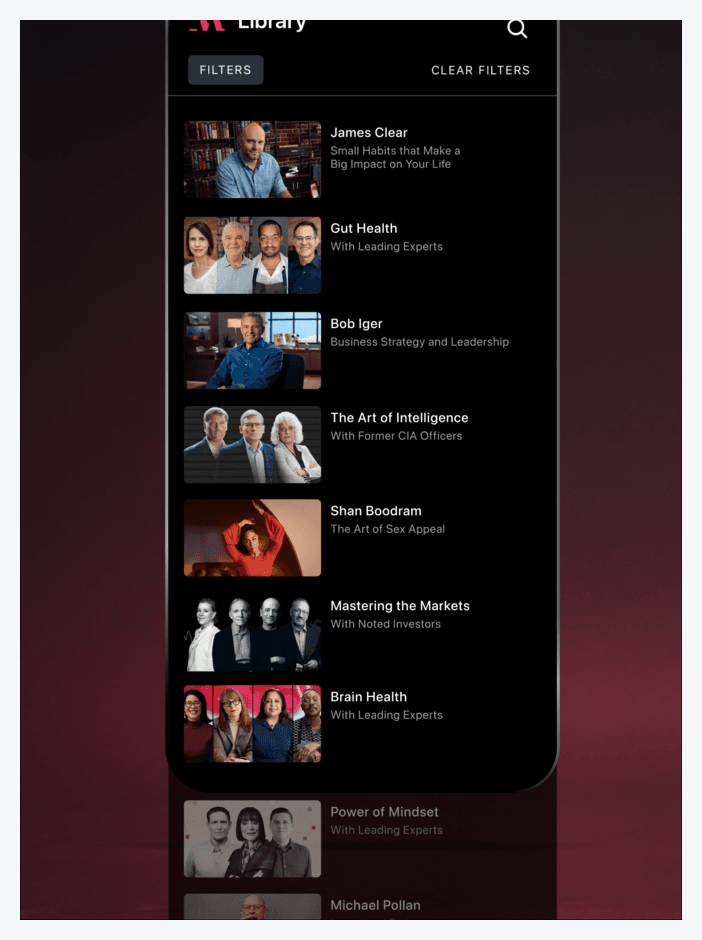
Discovery. A filterable catalogue — the merchandising surface of a subscription business.
Official App Store screenshot — MasterClass (Yanka Industries), September 2026
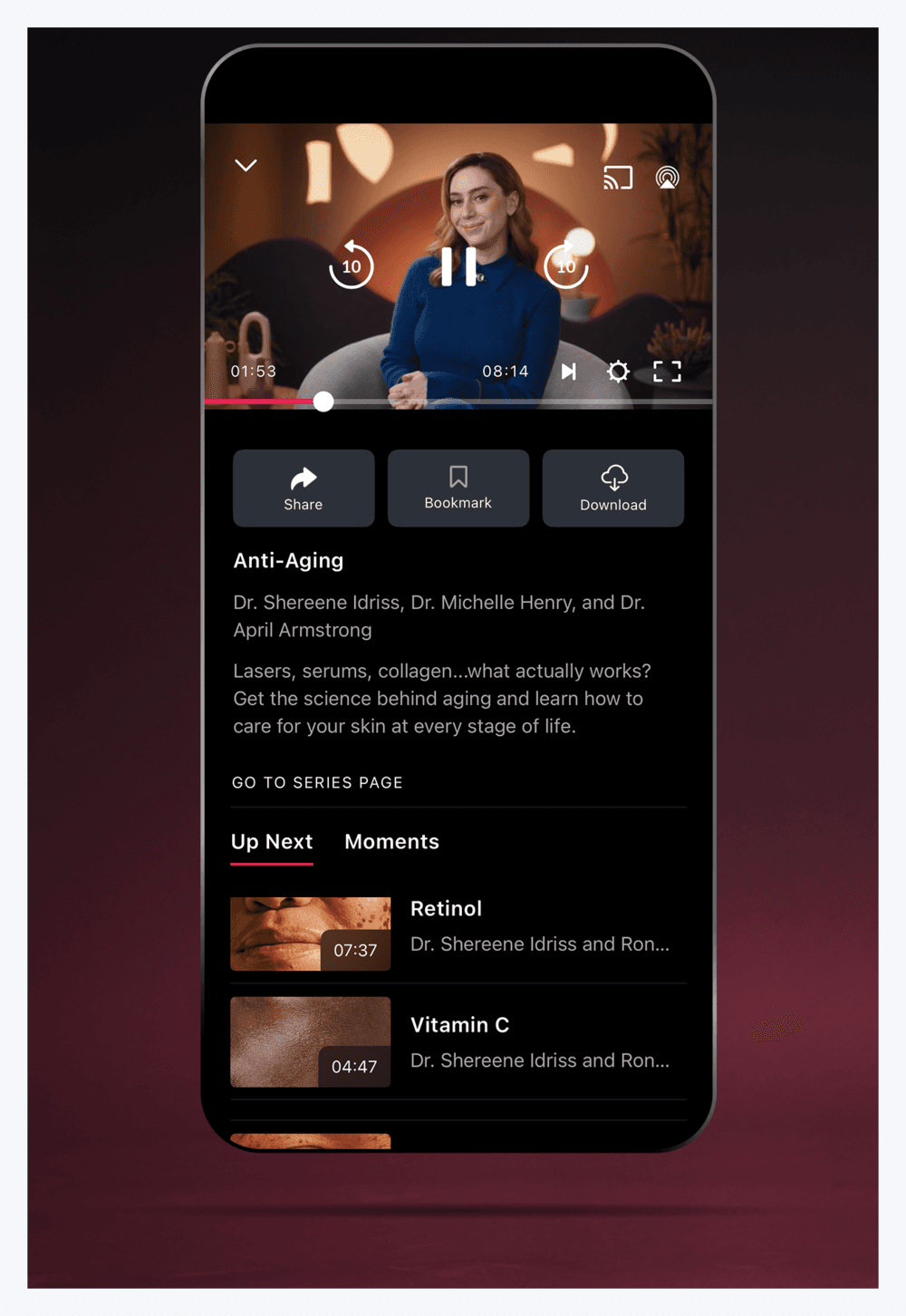
Delivery. A player, a description, and the next video queued. Nothing here can be answered, submitted or checked.
Official App Store screenshot — MasterClass (Yanka Industries), September 2026
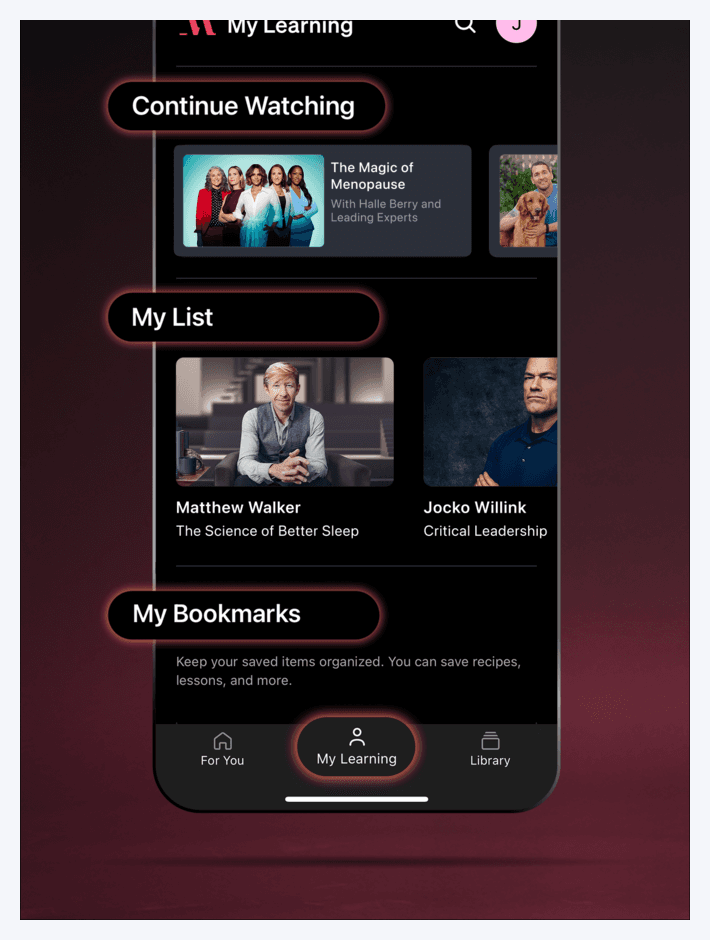
Return. Continue Watching, My List, My Bookmarks — retention mechanics borrowed from streaming, not from teaching.
Official App Store screenshot — MasterClass (Yanka Industries), September 2026
Preply — Learning Service. A learner takes a one-time CEFR placement test, searches a pool of 100,000-plus tutors, books, and then spends the bulk of their learning time in one-to-one video lessons with a person who adapts to them. Preply scores low on technology and high on dynamics, and the classifier names the tutor as what adapts rather than letting the label imply an algorithm. The company’s own framing is “human-led, AI-enabled”. Its own 2025 efficiency research reports that one in three learners moved up a full CEFR level in twelve weeks on pre/post measures — company-run rather than independent, but a measured-learning claim rather than a satisfaction claim.
The caveat is directional. Preply keeps adding software that does learning work: Lesson Insights, which produces automated post-lesson summaries naming areas to improve, and Daily Exercises, which generates practice between lessons. Read those as generously as the evidence allows — the software sets the tasks and marks the work — and Preply stays a Learning Service, with that layer reported alongside it as a second mechanism. It is a real and growing part of the product, and it is not what carries the learner's hour.
Preply: the product is finding and booking a person
The two surfaces a learner passes through before any teaching happens. Every control is a matching or scheduling control.
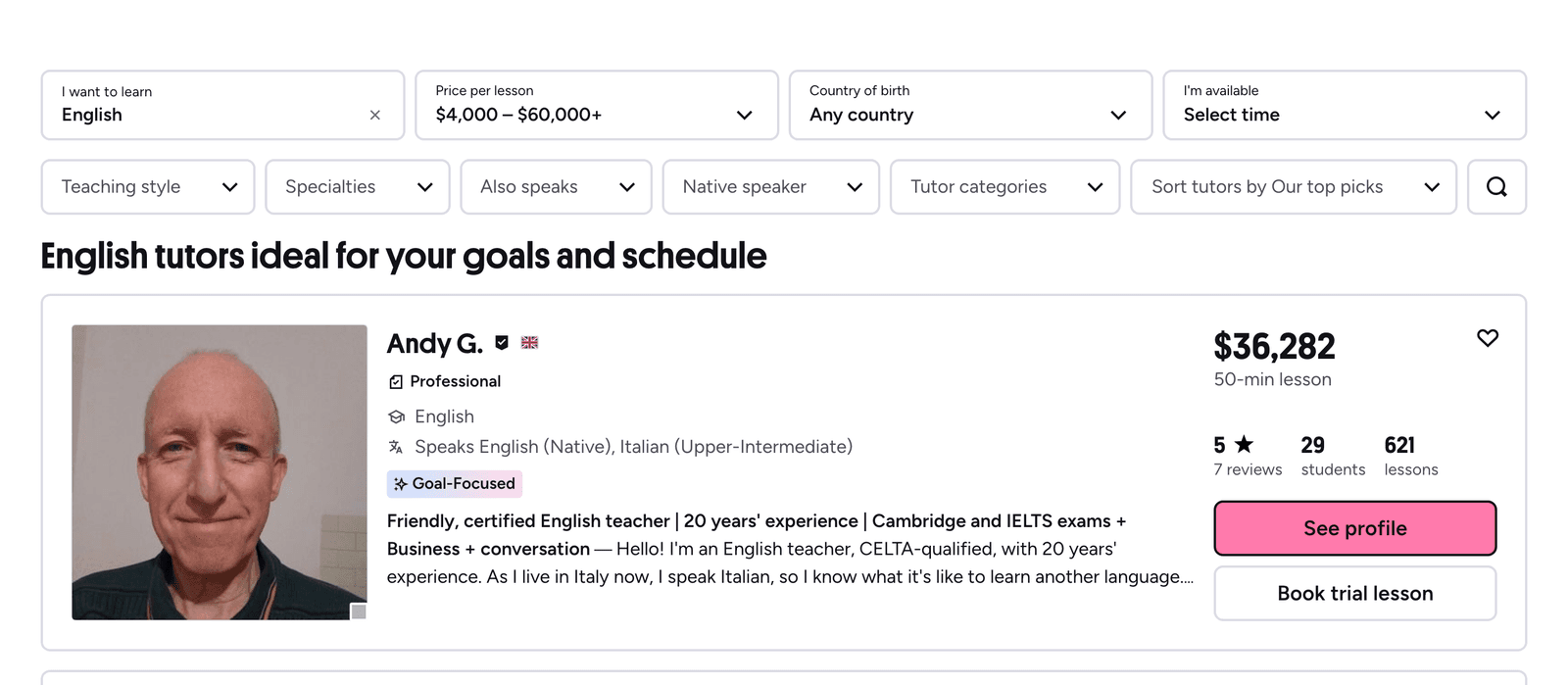
Matching. Filters for price, availability, country, speciality and teaching style — the machinery of a supply pool.
Live capture — preply.com tutor search, September 2026
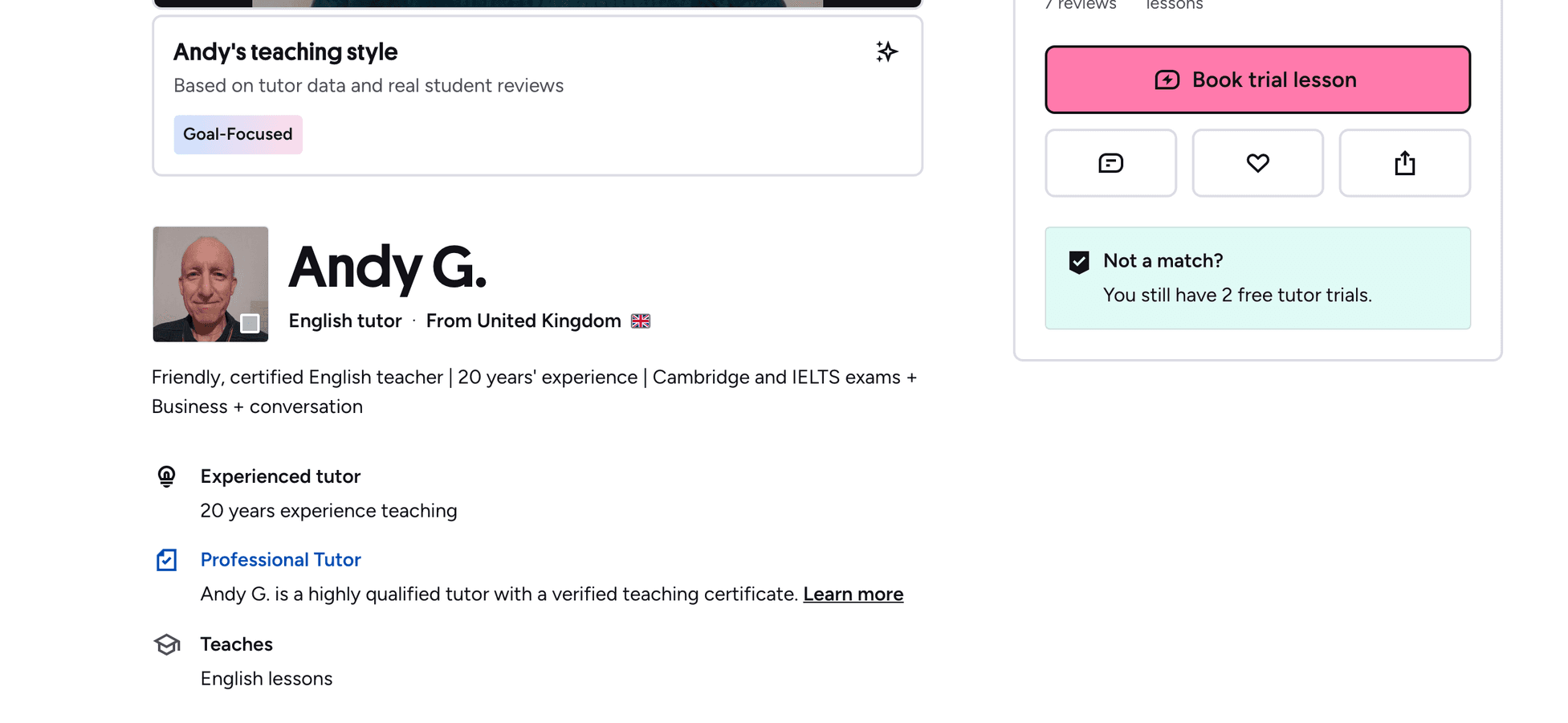
Booking. The software characterises the tutor — “teaching style, based on tutor data and real student reviews” — and then sells you an hour of their time.
Live capture — preply.com tutor profile, September 2026
Moodle — Learning Platform. I expected Coursera in this slot; it did not survive the test. Moodle does.
A learner opens the course their institution built, works through sections in the order a teacher set, submits assignments, takes automatically graded quizzes, and watches a gradebook fill up. The software does substantial real work — Moodle passed 500 million users on registered sites — and in a typical configuration, failing a quiz repeatedly means you may retake it. A change of plan requires a human teacher.
The caveat matters because it is not a limitation of the software. Moodle ships Restrict access rules that can gate an activity on a grade, and a Lesson activity whose pages branch on answers. A course authored that way classifies as a Learning Product. What the platform makes possible and what the platform decides are different things, and a PM working on Moodle is building the first while a teacher somewhere decides the second.
Moodle: structure authored by someone else
A course as a learner meets it. The software is doing real work — hosting, sequencing, grading, tracking — against a plan a teacher built in advance.
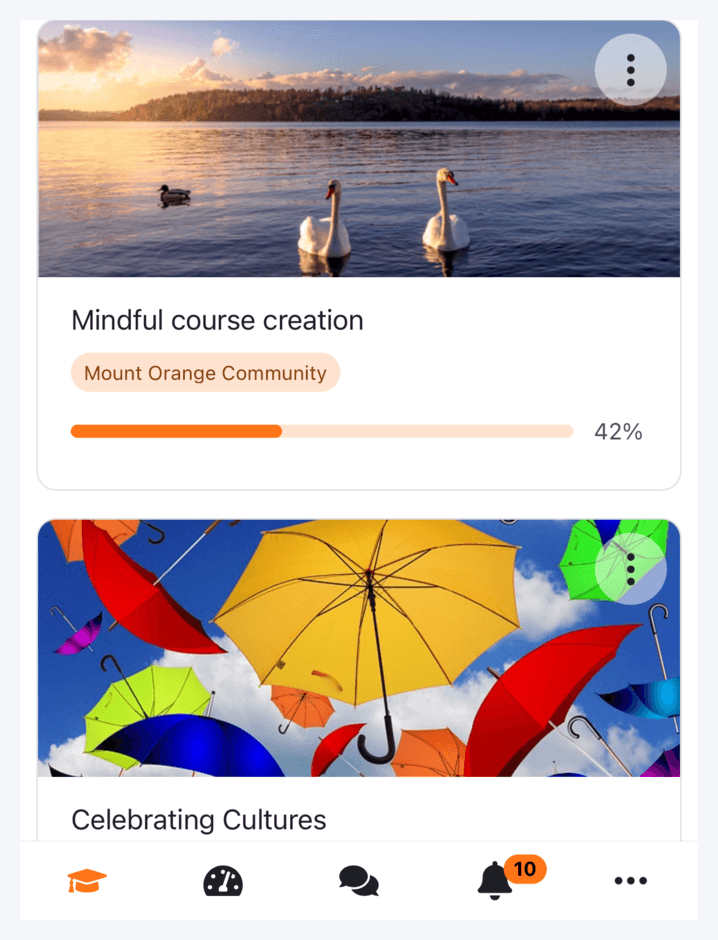
Position. Progress bars measure how far through the material you are, which is not the same as what you can do.
Official App Store screenshot — Moodle (Moodle Pty Ltd), September 2026

Delivery. Course, Participants and Grades — the three things an institutional platform is actually for.
Official App Store screenshot — Moodle (Moodle Pty Ltd), September 2026
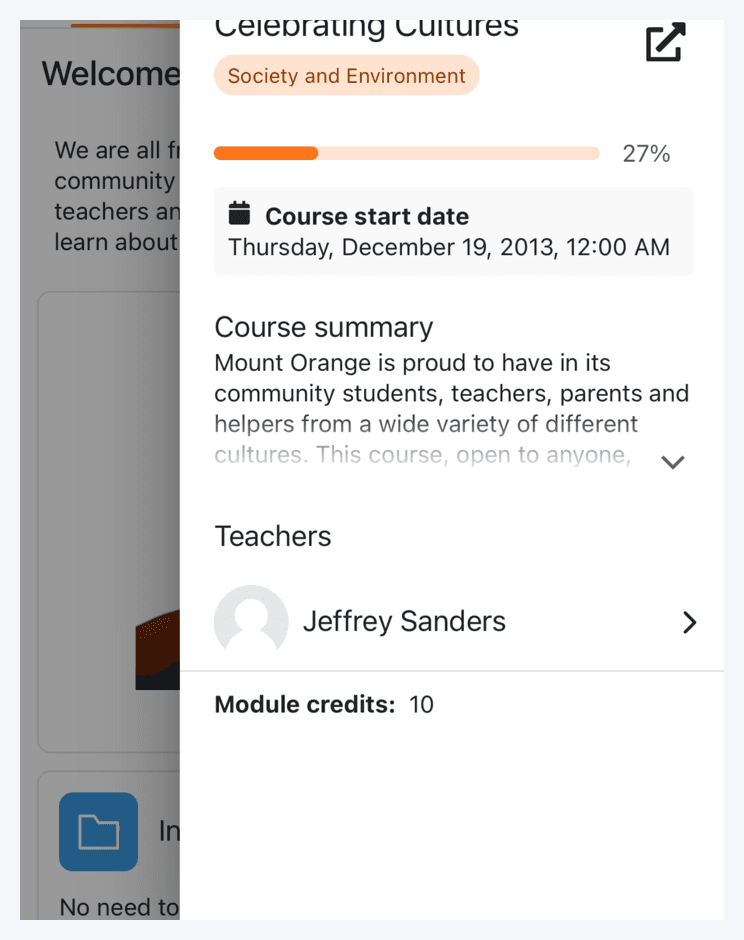
Authorship. A named teacher, a start date, module credits. The learning design belongs to a person, not to a model.
Official App Store screenshot — Moodle (Moodle Pty Ltd), September 2026
Codecademy — Learning Product. This is the one I most expected to have moved, because Codecademy has added a lot of AI in the last couple of years. A learner writes code in a browser workspace against instructions and the software runs it, checks it, and says what is wrong. The AI Learning Assistant reads the learner’s actual solution code and explains the error; project hints are generated against the current attempt; skill assessments dynamically generate questions and flag skills as “needs review”. That is unambiguously high on technology.
The path, though, is still the learner’s: you pick a career path or a course from a catalogue, and the sequence inside it does not reorganise itself around your weaknesses. Get something wrong and the lesson gives you a hint and an explanation — when you press the button for one — rather than a queue of targeted remediation. The Skill Tracking layer looks like the exception and is not: Codecademy’s own FAQ says skills are earned by completing content, and that assessments “reveal knowledge gaps for you to review”. Something is measured; nothing is queued. That is a Learning Product with a progress record, not an adaptive system, and the distinction is the whole point.
The classifier also flags that Codecademy’s stated proof is downstream: jobs, career outcomes, employer logos, rather than measured learning gain. Real learning machinery, career-outcome marketing, and no visible mechanism for detecting a graduate who cannot code is an extremely common combination, and it is where I would spend my interview questions.
Codecademy: a loop the learner is inside
The path is chosen from a catalogue; the work inside it is not passive. This is the combination that makes it a Learning Product rather than a platform.
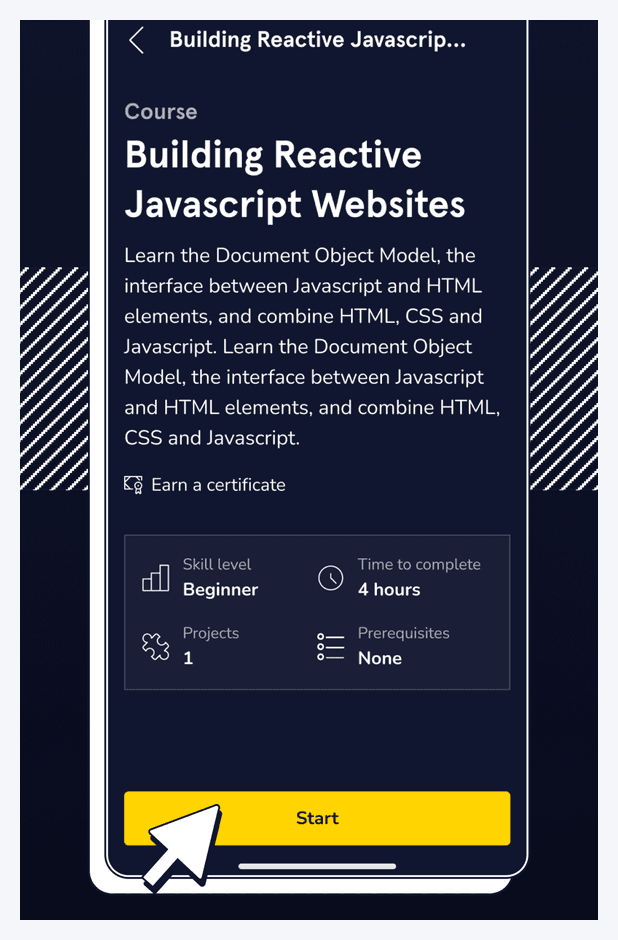
Choosing. Skill level, hours, prerequisites — the learner picks the route before any performance is observed.
Official App Store screenshot — Codecademy Go (Codecademy, LLC), September 2026
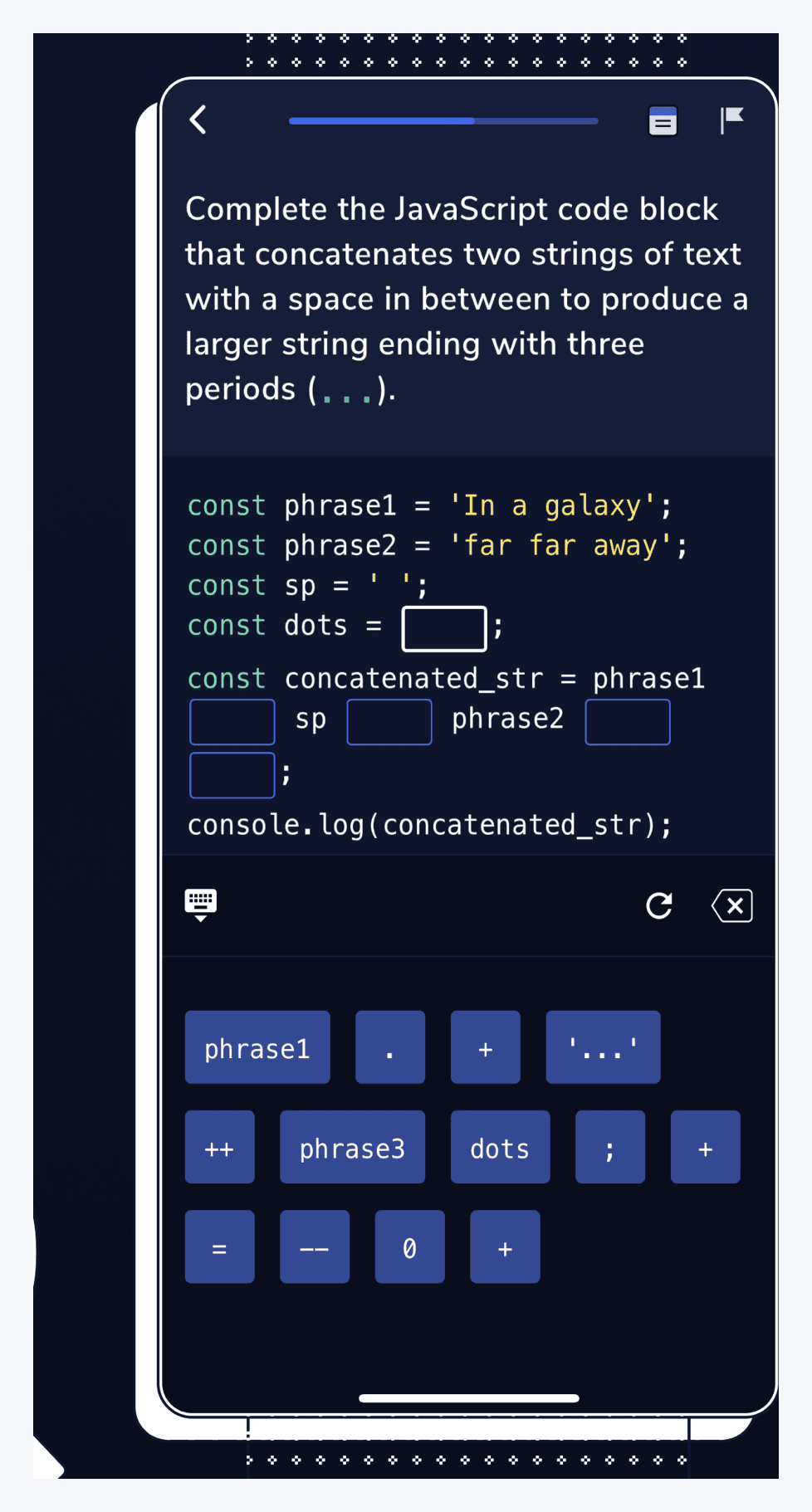
Acting. Instructions, blanks, and a checker waiting on the answer. The learner produces something the software will judge.
Official App Store screenshot — Codecademy Go (Codecademy, LLC), September 2026
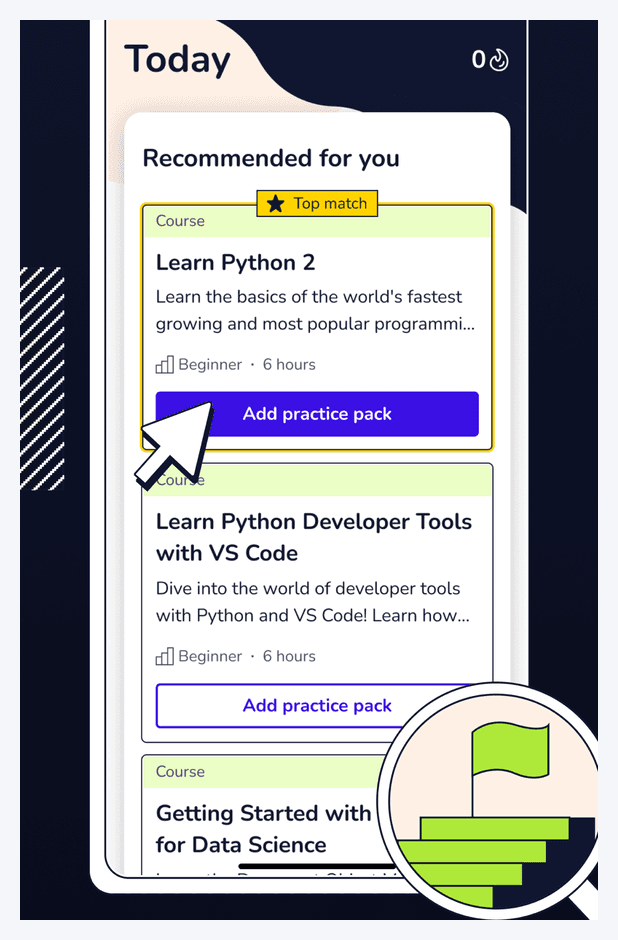
Recommending. Suggestions and practice packs sit beside the path — offered to the learner rather than imposed on it.
Official App Store screenshot — Codecademy Go (Codecademy, LLC), September 2026
Duolingo — Adaptive EdTech. Underneath the practice sits Birdbrain, which estimates both exercise difficulty and learner proficiency and updates them continuously; Duolingo’s own researchers describe the result plainly — the lesson that gets queued up is calibrated to your level and includes a review of things you got wrong last session. The Practice Hub assembles targeted practice out of your own recorded errors. All three dimensions read high, the software is what adapts, and the company publishes efficacy research, including the claim that its own teaching measurably improved between 2020 and 2024. That last part is what separates this category from the previous one: they operate a mechanism capable of telling them the product is not working.
The static half is real too. The course is a fixed tree that learners walk in roughly the same order, and a great deal of the content is authored rather than selected. Read the tree as the architecture instead of the exercise selection and Duolingo classifies as a Learning Product. Both readings describe the same company.
Duolingo: practice assembled from what you got wrong
The distinguishing surface. Content here is a consequence of the learner’s own record rather than a fixed list served to everyone.
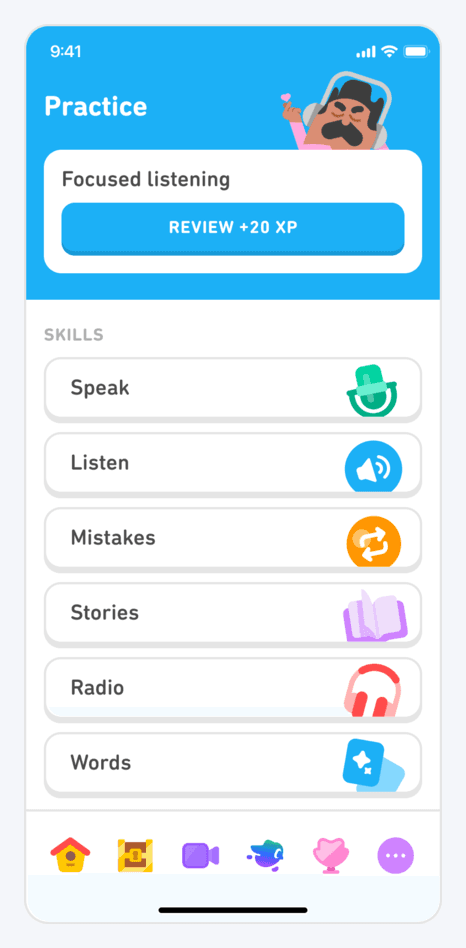
Surfacing. Mistakes is a first-class practice type, sitting alongside Speak, Listen and Words.
Official Duolingo product image, Practice tab announcement, February 2026
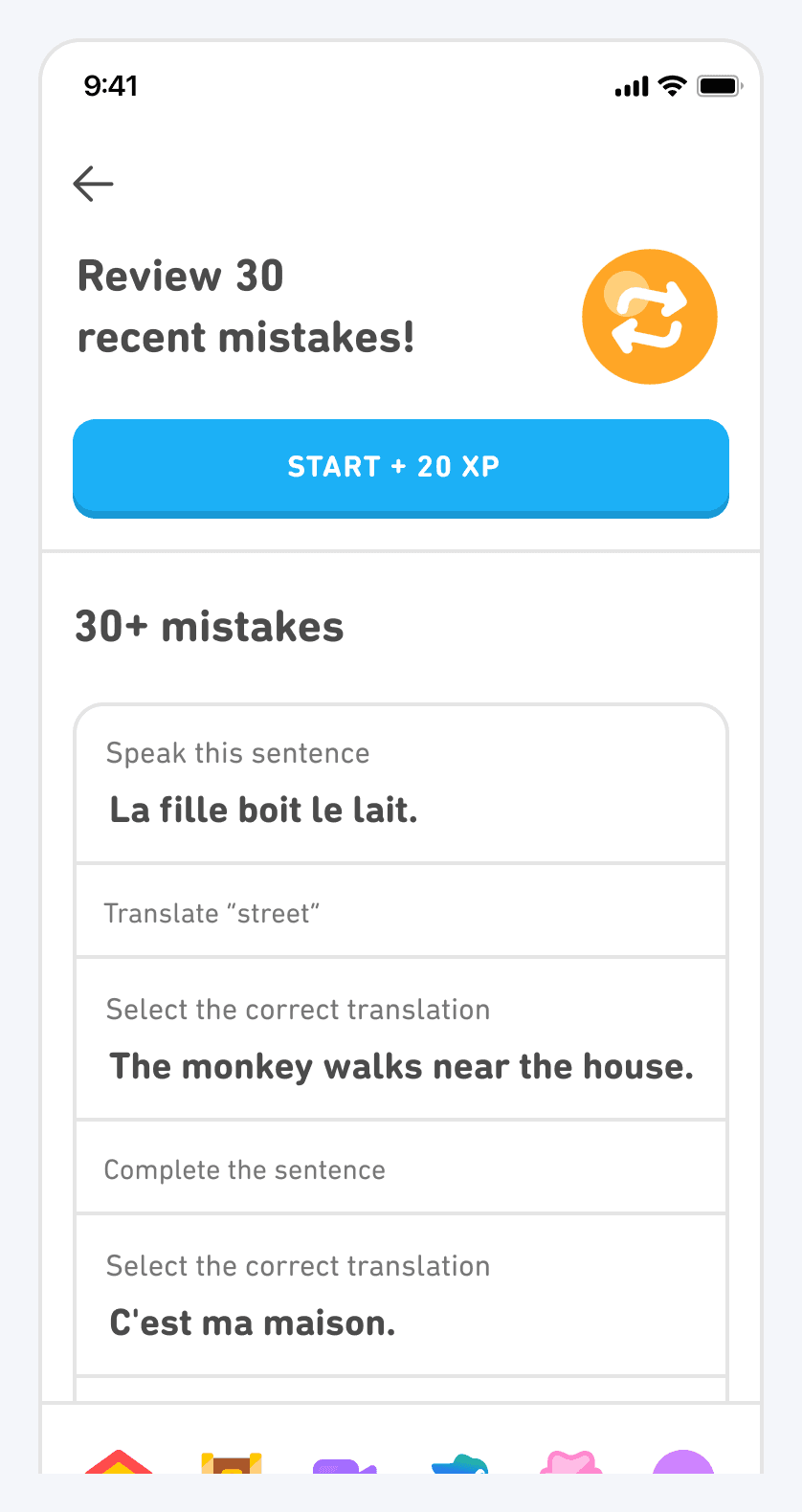
Selecting. Thirty recent mistakes, itemised — this learner’s errors, not a generic revision list.
Official Duolingo product image, Practice tab announcement, February 2026
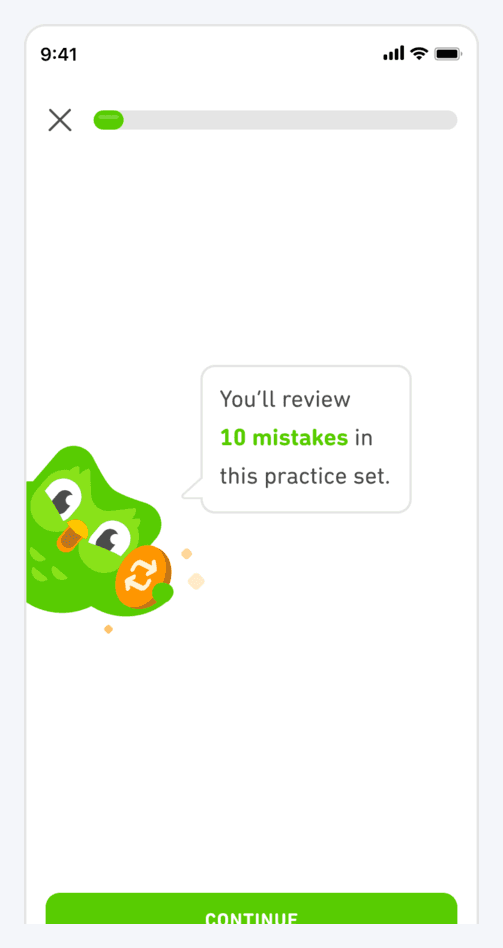
Closing the loop. The session announces how many of your own mistakes it is about to put back in front of you.
Official Duolingo product image, Practice tab announcement, February 2026
And the one that did not fit: Coursera. I assumed Coursera was the obvious Learning Platform. Tested honestly it is not, and which side it falls on comes down to a single judgement.
Read Coursera as courses — video lectures, auto-graded quizzes, peer-reviewed assignments, a catalogue you choose from — and it classifies as a Learning Platform. Read it including Coursera Coach and it does not. Coach explains concepts, quizzes learners, gives feedback and tracks progress across courses, and Coursera has separately rolled out AI grading that returns rubric-based feedback on written submissions. That is software doing learning work, which lifts technology to high; combined with the hints a struggling learner can now get on demand, the result lands on Learning Product.
I could have argued it back into the platform box; it is the example everyone reaches for, and it is where I expected it to land. The gap between my prior and the answer is the useful part: Coursera is a Learning Platform acquiring the characteristics of a Learning Product, and a PM interviewing there should work out which half of the company the role sits in.
Something similar came up more than once while I was re-testing these products. Several of them — Coursera, Preply, Udemy, Brilliant — now ship an assistant that explains, hints or generates practice, and each of those capabilities raises the technology reading on its own. Whether the dominant mechanism moved with it is a separate question, and for at least a couple of them I do not think it did. Six examples is not a survey, but an assistant attached to a catalogue can lift technology while leaving everything else where it was, which pushes the weight of the classification onto the other two dimensions.
What actually changes for the product manager
The differences below follow from mechanism rather than convention, so they hold in tendency rather than universally. Large companies contain several of these environments at once.
In EduCommerce, the structural fact is the gap in feedback speed: commercial signal arrives quickly, credible learning-outcome signal slowly or not at all. Most of what you ship gets judged against a number that closes at checkout, and that asymmetry shapes the job. A week tends to look like acquisition economics, pricing and packaging, checkout and instalment flows, refunds, and sequencing launches with marketing. Discovery is mostly buyer research rather than learner research. The constraint you do not control is usually catalogue supply, because producing an instructor-led course is slow and expensive. Technology is enabling rather than core — the hard engineering is payments, localisation and video delivery. Metrics look like CAC and payback, visit-to-purchase conversion, ARPU, refund rate. This transfers cleanly to and from consumer e-commerce and subscription businesses, and poorly to anywhere the product has to keep working after the sale.
In a Learning Service the capacity and quality of human time is the product problem. How that shows up depends on the company: Preply is a marketplace of independent tutors, but the same archetype covers cohort schools with employed instructors and coaching businesses working from a contracted bench, and the constraint moves accordingly. What tends to hold is that supply is a live variable rather than a fixed input, so a lot of the week goes to whether a learner can get a good match quickly, to scheduling reliability, and to the tooling instructors plan and teach with. That tooling is usually a first-class product rather than internal admin, and PMs who treat it as admin tend to struggle, because instructor churn shows up in learner retention a couple of months later. The hard measurement problem is teaching quality: star ratings capture likeability and punctuality at least as much as teaching, and building something better is often the highest-leverage work available. Metrics look like match rate, time to first session, rebooking rate, instructor utilisation, contribution margin per session. In the marketplace variants, experience from mobility or home services often transfers better than most EdTech experience does.
In a Learning Platform the leverage sits in delivery quality and in the authoring pipeline — how well the platform lets somebody else express a learning design, and how well it holds once they have. Time goes to activation and the first week, drop-off at specific modules rather than in aggregate, and the tools the content team lives in. The second user group is the interesting part: instructors, authors and administrators are often more demanding than learners, and in institutional platforms the buyer is a third constituency again, with requirements — accessibility, data retention, interoperability standards — that consumer PMs rarely have had to price into a roadmap. Technical complexity is integration and scale complexity rather than modelling complexity. Metrics look like activation, first-lesson completion, module completion, cohort retention curves, with completion as the standing trap, since it measures reaching the end of the material and nothing else. B2B SaaS and content-management experience often transfers here more readily than consumer growth experience does.
In a Learning Product the quality of the loop is the product. The week is spent on practice mechanics, on what a learner sees after a wrong answer, on where difficulty steps, and on whether progress is legible enough that someone can feel it. Discovery changes character: you watch people fail, because learners cannot reliably report why they got stuck. Content and curriculum people tend to become collaborators on mechanics rather than suppliers of assets, and you need enough learning science to hold an argument about spacing and retrieval practice. The structural tension is that engagement is cheap to measure and learning is expensive, so experiments drift toward the cheap endpoint unless somebody keeps pushing back. Metrics look like progression rate, correctness over time, drop-off at specific skills, time to first demonstrated competence. A PM arriving here from EduCommerce often brings strong instrumentation instincts and very little calibration for what makes a good exercise — learnable, but slower to pick up than people expect.
Adaptive EdTech tends to turn it into a policy job. What you own is what the system selects next and why, rather than a screen, which pulls in learner modelling and mastery estimation, the item lifecycle from authoring through calibration to retirement, and the validity of the measurement the rest of the product rests on. Where feedback is model-generated it also means reviewing it for correctness rather than fluency. Dependencies usually run through learning scientists, psychometricians and ML engineers, and the job goes badly if you cannot disagree with them substantively. Metrics look like learning gain against pre/post or a mastery model, time to mastery, item quality, the predictive accuracy of the learner model — with engagement read as an input rather than as proof. Recommender-system and ranking experience often transfers into this more directly than EdTech experience does, which is the one place where my Rambler years — ML-powered ranking, personalization, recommendation systems — line up more cleanly than the EdTech ones.
The same job title, five different jobs
What a product manager is mostly doing in each environment, and what tends to transfer in and out. Compiled from the sections above rather than from any survey — this is the argument in table form, not data.
EduCommerce
- The loop you own
- Visit → lead → purchase → repeat purchase
- The hard problem
- Commercial signal is fast; learning signal is slow or absent
- Discovery looks like
- Buyer research, price sensitivity, message testing
- Metrics tend to be
- CAC and payback, conversion, ARPU, refund rate
- You depend most on
- Marketing, payments, and a slow content supply chain
- Transfers well from
- Consumer e-commerce and subscription businesses
Learning Service
- The loop you own
- Search → match → book → attend → rebook
- The hard problem
- Measuring teaching quality without leaning on star ratings
- Discovery looks like
- Two populations whose incentives only partly overlap
- Metrics tend to be
- Match rate, time to first session, rebooking, utilisation
- You depend most on
- The people teaching, and the ops around them
- Transfers well from
- Marketplaces — mobility, home services, healthcare
Learning Platform
- The loop you own
- Enrol → activate → progress → complete
- The hard problem
- Serving learners, authors and administrators at once
- Discovery looks like
- Cohort analysis plus qualitative work with instructors
- Metrics tend to be
- Activation, module completion, cohort retention
- You depend most on
- Content operations, and the institution that bought it
- Transfers well from
- B2B SaaS and content-management products
Learning Product
- The loop you own
- Attempt → feedback → difficulty → progression
- The hard problem
- Engagement is cheap to measure and learning is expensive
- Discovery looks like
- Watching people fail, because they cannot report why
- Metrics tend to be
- Progression rate, correctness over time, time to competence
- You depend most on
- Curriculum people, as collaborators on mechanics
- Transfers well from
- Consumer product and game design
Adaptive EdTech
- The loop you own
- Observe → estimate → select → measure
- The hard problem
- Whether the measurement the product rests on is valid
- Discovery looks like
- Pre/post studies and offline evaluation with researchers
- Metrics tend to be
- Learning gain, time to mastery, item quality, model accuracy
- You depend most on
- Learning scientists, psychometricians and ML engineers
- Transfers well from
- Ranking, recommendation and other ML products
Differences in emphasis, not exclusive ownership. Growth matters in a Learning Product too, and learning outcomes can matter enormously to an EduCommerce business that sells on results — the claim is only about where the centre of the job usually sits.
Where the weight falls
The same point compressed. This is a qualitative reading of the framework, derived from the argument above — not a survey, not a measurement, and not a scorecard of how good a PM is.
- Lower emphasis
- Meaningful
- Central
EduCommerce
- Growth and acquisition
- Central
- Pricing and monetization
- Central
- Marketplace and service ops
- Lower emphasis
- Content systems and authoring
- Meaningful
- B2B and admin workflows
- Lower emphasis
- Learning experience design
- Lower emphasis
- Experimentation
- Central
- Learning science
- Lower emphasis
- Data, ML and AI product work
- Lower emphasis
- Personalization
- Lower emphasis
- Outcome measurement
- Lower emphasis
Learning Service
- Growth and acquisition
- Meaningful
- Pricing and monetization
- Meaningful
- Marketplace and service ops
- Central
- Content systems and authoring
- Meaningful
- B2B and admin workflows
- Meaningful
- Learning experience design
- Meaningful
- Experimentation
- Meaningful
- Learning science
- Meaningful
- Data, ML and AI product work
- Lower emphasis
- Personalization
- Meaningful
- Outcome measurement
- Meaningful
Learning Platform
- Growth and acquisition
- Meaningful
- Pricing and monetization
- Lower emphasis
- Marketplace and service ops
- Lower emphasis
- Content systems and authoring
- Central
- B2B and admin workflows
- Central
- Learning experience design
- Meaningful
- Experimentation
- Meaningful
- Learning science
- Meaningful
- Data, ML and AI product work
- Meaningful
- Personalization
- Lower emphasis
- Outcome measurement
- Meaningful
Learning Product
- Growth and acquisition
- Meaningful
- Pricing and monetization
- Meaningful
- Marketplace and service ops
- Lower emphasis
- Content systems and authoring
- Meaningful
- B2B and admin workflows
- Lower emphasis
- Learning experience design
- Central
- Experimentation
- Central
- Learning science
- Central
- Data, ML and AI product work
- Meaningful
- Personalization
- Meaningful
- Outcome measurement
- Meaningful
Adaptive EdTech
- Growth and acquisition
- Meaningful
- Pricing and monetization
- Lower emphasis
- Marketplace and service ops
- Lower emphasis
- Content systems and authoring
- Meaningful
- B2B and admin workflows
- Lower emphasis
- Learning experience design
- Central
- Experimentation
- Central
- Learning science
- Central
- Data, ML and AI product work
- Central
- Personalization
- Central
- Outcome measurement
- Central
Read a column as a job description and a row as a career question: the same skill is worth a different amount depending on which environment you are standing in. A “lower emphasis” cell does not mean the skill is unwelcome — it means it is unlikely to be what the role is judged on.
Why the label got broad and stayed broad
There is a reason one word ended up covering all five. The set of things software can do inside learning has expanded steadily for six decades, and each new capability was absorbed into the same vocabulary rather than given its own. What follows is not a story of progress replacing itself — every one of these capabilities is still being shipped, and most products combine several.
What software became able to do, and roughly when
A conceptual sequence of capabilities, each dated by a concrete first appearance rather than by an era label. The ordering is by when a capability became demonstrable, not by importance.
1960s
Present material, and respond to an answer
The first generalised computer-assisted instruction system already did the thing that still defines the low end: show material, accept a response, branch on it.
PLATO, begun by Donald Bitzer at the University of Illinois in 1960 — Illinois Distributed Museum.
1970s–80s
Model what an individual learner knows
Intelligent tutoring research moved from branching to representing the learner’s knowledge state, which is what makes a response to this learner possible at all.
Formalised for practical systems as Bayesian knowledge tracing by Corbett and Anderson, building on cognitive tutor work through the 1980s.
1990s–2000s
Run the institution’s learning, at scale
The web turned software into the place courses live: enrolment, sequencing, assignments, grading and records. This is the capability most of the world’s learning software still provides.
Moodle’s first release in 2002 followed the commercial LMS generation of the late 1990s.
2008–2012
Distribute a course to anyone, anywhere
Open enrolment at internet scale separated access from instruction — and made it very visible that reaching millions of registrations is not the same as teaching them.
Across edX’s first six years, Reich and Ruipérez-Valiente found completion stayed low and did not improve, and the sector pivoted toward paid credentials.
2010s
Hold the practice loop itself
Mobile, gamified products moved the centre of gravity from watching to doing: short sessions, immediate checking, streaks and progression carried inside the software.
Feedback is the mechanism doing the work here, and it is not automatically benign — Kluger and DeNisi found over a third of feedback interventions reduced performance.
2015 onward
Choose what comes next from a running estimate
Learner models moved from research systems into consumer products, selecting exercises and difficulty per learner rather than serving a fixed sequence.
Duolingo’s Birdbrain is a production example, described by its own researchers in 2023.
2023 onward
Generate the explanation, the item, and the feedback
Language models made explaining, hinting and item generation cheap enough to attach to products that were never built around a learning loop — which is exactly why the technology dimension has stopped separating products on its own.
UNESCO’s 2023 Global Education Monitoring Report reviews the evidence base and argues for keeping human interaction central rather than substituting for it.
Capabilities accumulate; they do not replace one another. A product shipped in 2026 may sit anywhere on this list, and a company selling recorded video is not a relic — it is using an earlier capability because that is the business it is in.
That accumulation is the whole problem with the label. “EdTech” was coined when the top of that list was a branching quiz, and it has been stretched over every capability added since without ever splitting. The word did not get less accurate; the space underneath it got much more heterogeneous.
So what are those five years supposed to mean?
When a job description asks for five years of EdTech experience, what is it asking for?
Usually it is doing several jobs at once without the writer having decided which. Sometimes it means: this person will not need the vocabulary explained, and will not waste a month discovering that the buyer and the learner are different people. Sometimes it means: we have been burned by someone who treated education as content marketing, and we want a signal that the candidate takes the subject seriously — reasonable, and not really about years. And sometimes it is standing in for a specific mechanism the company has not articulated, that the role is really about difficulty curves or really about instructor supply, in which case it is the one meaning that would actually predict performance and the one the phrase cannot communicate.
Some things do carry across all five environments. Instrumentation habits transfer. So does tolerance for slow feedback loops, because learning outcomes take weeks or months to become visible and you get fewer and later signals than in most consumer software. So does the buyer-is-not-the-learner reflex. “EdTech experience” is not meaningless; it is a great deal smaller than it sounds, and the part that transfers is rarely the part being asked about.
The practical version is to treat the phrase as an unfinished sentence rather than a credential. When a company asks me about EdTech experience, the useful move is to establish which environment they are before answering: talking to an EduCommerce business the Ray years are the relevant ones, and talking to a company building learning loops it is Tomus, which I should say rather than let 18 million downloads do work it cannot do.
Going the other way, the questions worth asking before joining are mechanical rather than cultural. What is a learner actually doing for most of a session? What happens in the product when someone gets the same kind of thing wrong three times? What decides what they do next? When you tell an investor the product works, what number do you show them? And the one that reveals the most: if a cohort finished and had not learned the skill, how would you find out?
The last one is slightly unfair and I ask it anyway. Plenty of respectable companies have no answer, and there is nothing disqualifying about that. What the answer tells you is whether “does this product work?” gets settled with learning data or with engagement data, which is a reasonable predictor of the arguments you will be having for the next two years.
From an intuition to something I could hand over
For a long time this lived in my head as a reflex: this feels like one kind of EdTech, that feels like another. That works until somebody asks you to justify it, or until you want to hand it to someone else, and I kept having the same forty-minute conversation with founders and with PMs deciding between offers.
So I turned it into a tool, which now sits on this site: What kind of EdTech is this?
It asks eight questions and takes about three minutes, with a few follow-ups that appear only when an answer makes them worth asking. Nothing is scored or averaged: each mechanism is either shown by an answer you gave or it is not. One question asks what the role you are looking at would actually own and deliberately has no effect on the classification; it exists so the result can tell you when a job is a monetization job inside a company with a real learning product, which is common, legitimate, and better known in advance than discovered in month three.
Two design decisions make it usable from outside a company. “Can’t tell from what I’ve seen” is a first-class answer: it withdraws only the conclusions that depended on it and leaves the rest standing, so not knowing how a company makes money cannot erase what you established about the teaching. Each unknown comes back as a question to ask them. A tool that punishes you for admitting you do not know just teaches you to guess. The other is that the mechanisms are reported separately rather than collapsed into one verdict, because the mismatches are the useful part.
Everything runs in the browser; the result link encodes your answers rather than a stored verdict, so anyone who opens it re-derives the same result from the same logic. When I ran Tomus through it — my own product, so I could not blame the inputs — it came back as a Learning Platform rather than the Learning Product I would have called it. The reason is legible in the answers: there was real practice and automatic checking inside the product, and what a learner got right or wrong did not change what came next.
If you are looking at an EdTech role right now
Take the company you are considering, or the job description you have been rereading, and run it through the classifier. Answer from what you can actually observe — the product, a trial, the careers page, what they said on the first call — and say “can’t tell” wherever that is the truth.
The tool is What kind of EdTech is this? — eight questions, about three minutes, and it will tell you which of the five environments you are looking at, what the PM job there tends to emphasise, and what to ask them.
It will not tell you whether to take the job. What it should do is tell you which of the five jobs you are being offered, which is the part the job description usually leaves out.
Sources & research19 sources
Research & context
- VanLehn (2011), The Relative Effectiveness of Human Tutoring, Intelligent Tutoring Systems, and Other Tutoring Systems — Educational Psychologist
- Bloom (1984), The 2 Sigma Problem — Educational Researcher
- Corbett & Anderson (1995), Knowledge Tracing: Modeling the Acquisition of Procedural Knowledge
- Kluger & DeNisi (1996), The Effects of Feedback Interventions on Performance — Psychological Bulletin
- Reich & Ruipérez-Valiente (2019), The MOOC pivot — Science
- UNESCO (2023), Global Education Monitoring Report — Technology in education
- PLATO — Illinois Distributed Museum, University of Illinois
- Bicknell, Brust & Settles (2023), How Duolingo’s AI Learns What You Need to Learn — IEEE Spectrum
Product evidence
- MasterClass — Sessions
- MasterClass — Certificates
- Preply — Proven Progress, 2025 efficiency research
- Preply — AI-powered features announcement
- Moodle — 500 million users on registered sites
- Codecademy — AI features available on Codecademy
- Codecademy — Skill Tracking FAQ
- Duolingo — guide to the Practice tab
- Duolingo — efficacy research
- Coursera — Coursera Coach
- Coursera — AI grading in peer reviews